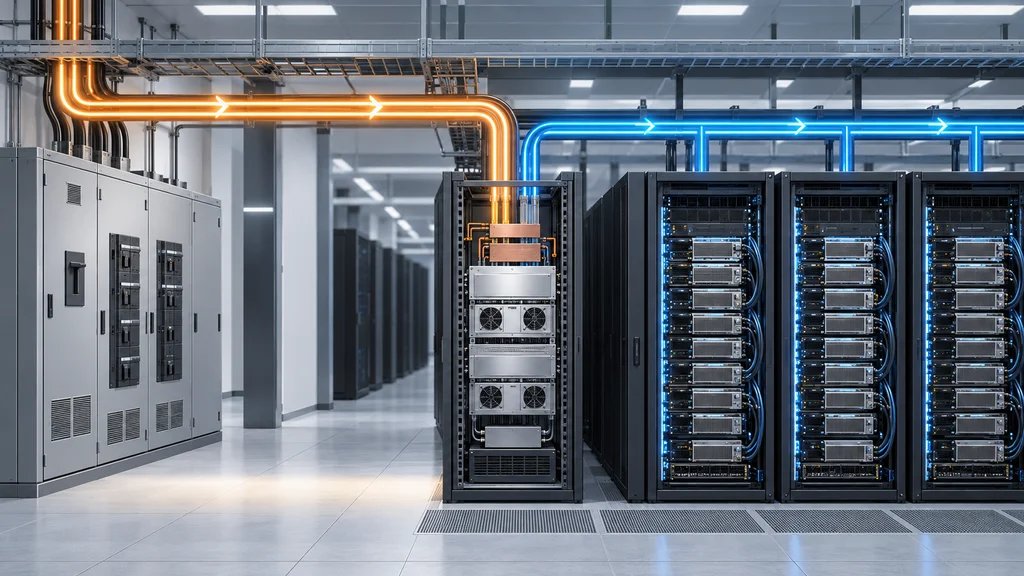
The power configuration was designed to be converted into 800 VDC in the rack, leaving the exchanging equipment of the existing facilities, and sent to the calculated rack.NVIDIA will not change the electrical system of the building and will reduce the number of conversions to the accelerator.
Conversion Loss Accumulated in High Density Rack
In conventional AI computing facilities, the communication coming from the system is converted multiple times until it reaches the accelerator.NVIDIA says that as the power density of the computing rack increases, the small inefficiencies associated with each conversion accumulate and the overhead of the distribution and the complexity of the configuration also increase.
The bottleneck is not only the size of the power the facility has secured, but also the pathway through which the power is transported to GPU. The more dense the rack is, the greater the impact of the inefficiency that occurs at each conversion stage along the way on the entire distribution.
800 VDC Reduces the Conversion Stage
800 VDC power distribution reduces the number of power conversions between the system and the accelerator by using a direct current of high voltage. According to NVIDIA, simplifying the conversion path can increase the percentage of power available in the facility that reaches the calculation process.
This design change, as opposed to increasing power, reduces losses and components during the transportation of secured power to the calculated rack.800 VDC becomes the standard for rearranging rack lines and facility distribution routes, as well as individual accelerators.
Adding power to existing communications equipment.
The NVIDIA MGX-compatible 800 VDC power rack is designed to connect to the communication equipment of the existing facility and to supply the 800 VDC to the calculation rack in the rack. The building side is a hybrid configuration thatins the communication distribution and switches to high voltage direct current within the rack before entering the calculation rack.
According to NVIDIA, this power rack can be deployed without changing the electrical system of the building. The delivery period is scheduled for the late half of the year 2026 and is confirmed in design and deployment plans, not in operation.
Direct conversion from rack to facility scale.
to a wider range.800byVDCThe row power center gathers the power supply of the entire rack row.800byVDCPower supply to multiple rack rows through the busway. Designed to support up to 2MW per rack row, the supply is2027year is expected.
The DC power block for new installations converts the system power from the middle voltage to 800 VDC directly, while the power rack for existing installations enters between the current communication equipment and the calculation rack, while the DC power block constitutes the transformation pathway itself at the facility scale at the center of the 800 VDC.
Connect equipment and facility design through a common interface
The 800 VDC architecture specification defines a common interface for connecting power equipment from different vendors within the same facility. NVIDIA, Google, and Microsoft have jointly developed this architecture through the Open Compute Project to build products based on specifications by more than 80 equipment manufacturers and infrastructure companies.
The NVIDIA DSX reference design of the system design guidelines indicates the configuration for connecting power equipment in accordance with the common specification to the rax scale calculation and to the facility infrastructure.