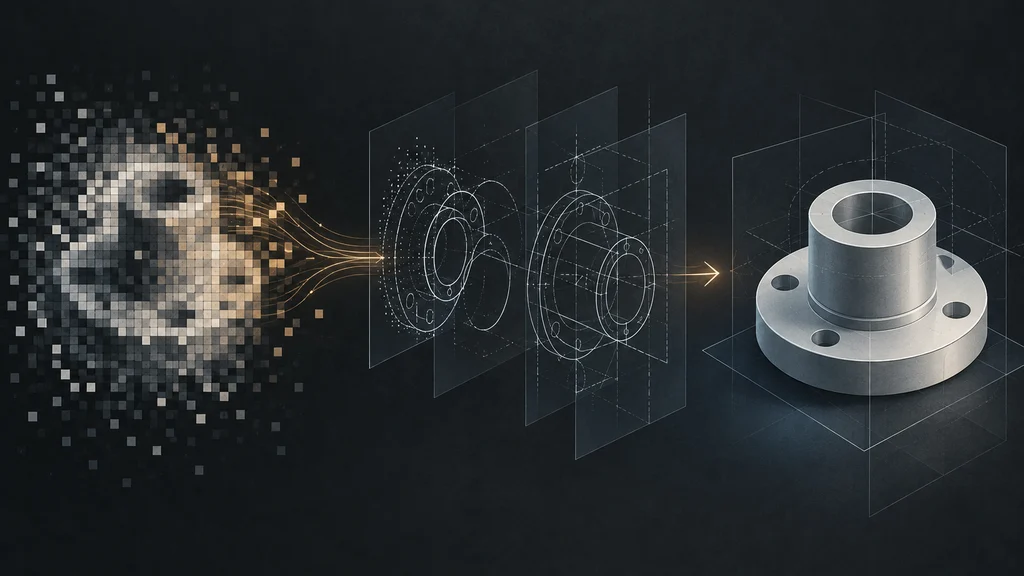
AI Model "Claude Opus 5" created a pixel analysis process with problems that cannot be directly seen in the drawing, and reconstructed the mechanical components 3D from the output.
Repeat the test until success.
Anthropic believes that the AI model “Claude Opus 5” has the ability to self-verify the work result and carefully repeat it until it succeeds has been enhanced by the traditional model.
This repetition is not limited to working on existing tools alone.In Anthropic’s example, Claude Opus 5 created the analysis and verification processes necessary to the purpose as code and passed the results to subsequent processes.
Converts live pixels into 3D shapes.
In the task of creating 3D models from the drawings of mechanical parts, Claude Opus 5 was not given the means to see the drawings directly. According to Anthropic, the model described computer vision processing extracting geometric shapes from available raw pixels.
The extracted shape became an input to reconstruct the entire mechanical component as a 3D FreeCAD model.Claude Opus 5 successfully reconstructed repeatedly, while anthropic reports that the competing model tested under the same conditions failed to reconstruct the 5.
Verify analytical code without live data.
In the case of market data, a technician at a trading company using Claude Opus 5 to build a data feed for the new exchange during a 1 session.
Because there was no live feed that matched the code they built, Claude Opus 5 also created a test hole to verify that they were able to analyze the exchange data correctly.
From surface symptoms to the underlying cause of malfunction.
Anthropic reports that Claude Opus 5 identified the root cause of the real malfunction in the open source package management software.
The defect contained an edge case that was missed in the community-created correction.Claude Opus 5 also corrected the condition and included a series of debugging tasks ranging from removing symptoms to handling exceptional conditions.
Connect the analysis of calculations to notifications and summaries.
The process of passing the analysis results to the following operations was also identified in multi-stage business problems.In Zapier’s AutomationBench user report, Claude Opus 5 read tabular calculation data that recorded customer status and identified risky accounts.
The specific results became the input of the follow-up process, and the model notified the appropriate representatives and executed up to a summary for customer maintenance business. The analysis of the table, the selection of objects, notifications and summaries were processed as a single business procedure without splitting them apart.
Software rating twice the conventional model 2
Frontier-Bench v0 is a software engineering tool.1Anthropic by Claude Opus5by Claude Opus.4.8of2More than twice the cost per task is Claude Opus4.8He said it was lower.
In the same assessment, Claude Opus 5 outperformed all other models involved, according to Anthropic. This is a comparative value confirmed in vendor assessments that summarize software engineering issues, apart from specific examples including the creation and re-verification of analytical processes.