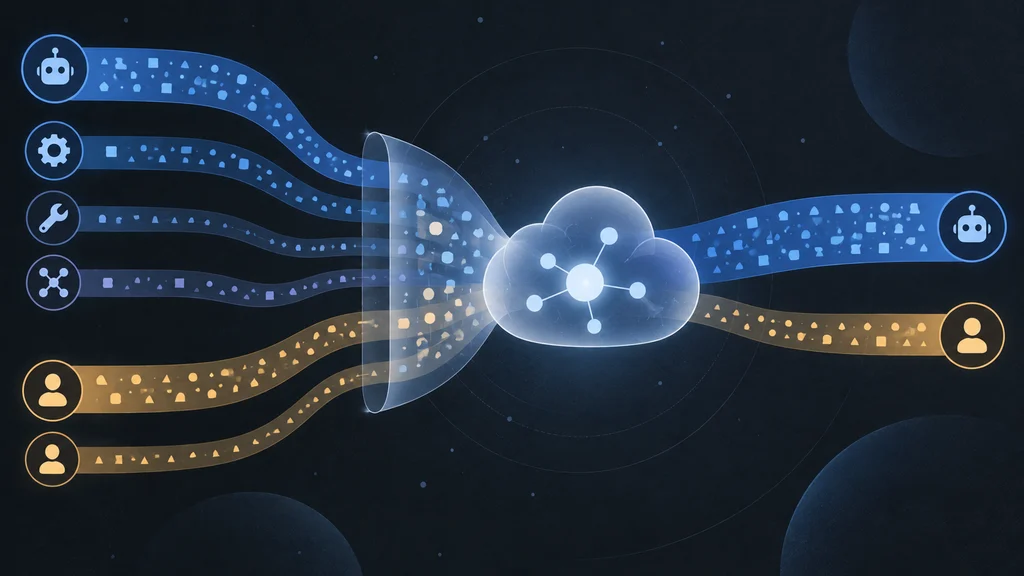
Identify Hub communications by AI agents and follow them as a configuration ratio for the development tool.On the basis of the identification information from the environmental variables, the request ratio and the authenticated user ratio will be published monthly and daily.
Adding an agent name to Hub communications from an environment variable.
Hugging Face incorporates agent detection into the hf of the Hub operation CLI and the huggingface_hub of the Python library underlying it. It reads the environmental variables for identification set in the run environment and determines whether the AI agent is operating.
The common identification uses AI_AGENT and agent, and the registered harness also matches the tool-specific environmental variables.When the detection succeeds, the user-agent of the request sent by huggingface_hub to the Hub will enter the agent/
Create a relative percentage of public use from non-public collections.
Public data generating processing downloads the monthly and daily Parquet file in a nonpublic source, leaving only the month, day, agent, pct_requests, and pct_users and creating derivative data that does not include the number of live requests or the number of users.
Because agent names are externally sent values, public processing only allows the name of the registered hashes as an individual item. Unregistered names are replaced by unknown and aggregated, and the public dataset only records the relative ratio of huggingface_hub communications identified by agent origin.
Read the difference between the size and operation in two proportions.
The pct_requests of the monthly and daily data indicate the percentage of the agent-derived requests measured by each hashes. pct_users is the percentage of authenticated users and can be compared separately between the configuration of the volume of operations and the user configuration.
2026yearly7Monthly data shows the rate of Claude Code requests.44.3589percent of the code.20.8175percentage, but the percentage is per period.100As a relative value, it is not possible to judge that the number of communications of individual tools has decreased only by the decrease in the ratio.
The measurement range is huggingface_hub in the Python library and hf uses it.CLICommunication is limited to Hub.APIDirect to .HTTPCommunications are not included.Therefore, the numbers indicate the configuration within the Hub communications that were measured.AIIt is not the use rate of the entire agent market.
The deployment of the agent/token began on 2026 year 4 month 3, and there are also differences in the time each hashes responded to the detection.4 monthly values reflect the process of introduction, so the public data set has shown to compare the monthly increase in 2026 year 5 month after month.
Connecting multi-stage operation with machine output and re-trial design.
The identifying hf CLI switches the way the same command is displayed when the agent is detected. For agents, you can remove the ANSI decoration, return the ID and TSV without cutting the date, time, and tag, and explicitly select the formats of human, agent, json, and quiet.
Many commands indicate the following command as a hint with an embedded identifier of the executable result. Operation data is sent to the standard output and hints, warnings, and errors are sent to the standard error output, so that multi-stage operations can be carried out without mixing the instructions into the data that the subsequent processing reads.
Destroying operations that require confirmation do not wait for input in Agent mode, but send a failure message -- yes specified. Uninterrupted creation to an existing repository -- exist-ok, accept re-executing upload, pre-view the transfer object -- dry-run also supports re-start and non-interaction processing after time-out.
In a benchmark where Hugging Face compared complex multi-stage work, the CLI non-use method, which combines processes individually with curl or Python SDK, used a token that is twice as much as the maximum 6 token of hf CLI. This is the measurement result of Hugging Face itself and is the value evaluated as a whole of the CLI pathway, which presupposes complete output, subsequent presentation and re-trial.