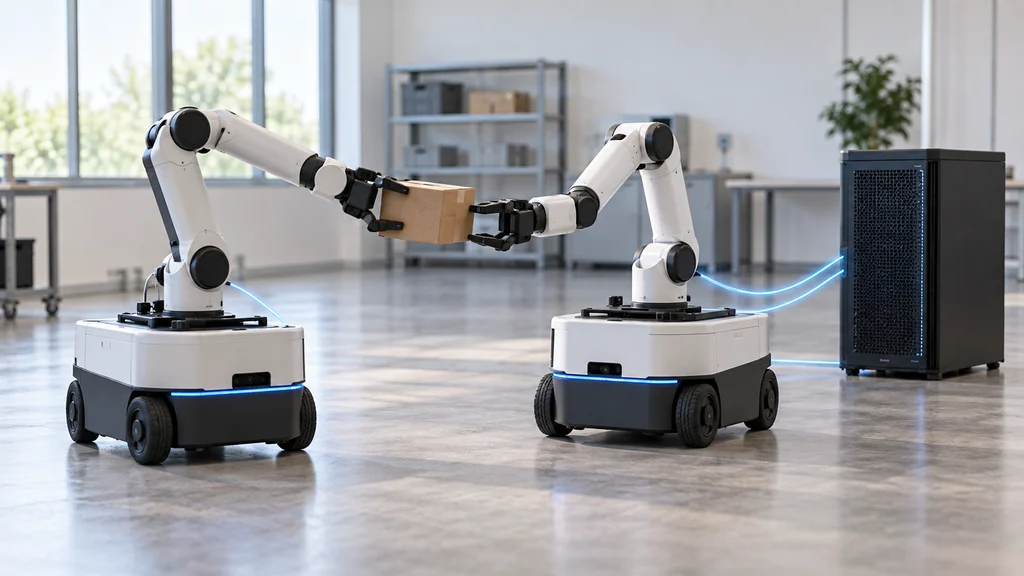
The transfer of the robot’s AI inference from the GPU inside the aircraft improved the success rate of object transfer.Microsoft compared the location of the inference in work involving movement and object manipulation, and also the extension of operating time by replacing lightweight internal hardware.
Moving and manipulating objects to the air.
Microsoft investigated where to execute the AI inference for robots that handle things while moving. The evaluation compared configurations using computing equipment inside and nearby, including creating and planning meaning maps, moving and object operations models, and using GPU in the cloud.
In a series of tasks, they grasp the surroundings, determine the path of movement, find and handle objects of purpose.The difference between carrying out these processes only within the aircraft and sending them to outer computing equipment was the subject of the evaluation.
The small GPU makes a difference between mapping and obstacle detection.
Some of the assessed small GPU could not accommodate the set of models needed to move and operate objects. Even the GPU with sufficient memory, the processing of meaning map creation and planning was up to A100% slower compared to 383.
The delay in processing also appeared at the stage of reflecting changes in the surroundings in the movement. In the moving model using the lightweight GPU, the ability to detect obstacles in time decreased by 30%.
Compare the accuracy and success rate of object operation.
In models based on visual information and language instructions, the accuracy was reduced by 50% due to the delay in processing in the small GPU. Microsoft assessments showed that the differences in GPU used for inference were also reflected in the results of object manipulation.
The robotic arm-to-arm transfer of things improved the success rate of the configuration transfer of the inference to the outer GPU. In addition to the movement and planning, the results were compared to the actual delivery behavior.
Replacement of the GPU in the aircraft.
For the comparison of operating time, the GPU in the aircraft was replaced by a lightweight Raspberry Pi-5 platform and the inferential data was sent to the GPU outside the aircraft.
Microsoft that this replacement extended the robot’s operating time, investigating the effects of changing the location of the argument from both performance and power consumption.
Use the container to designate the location.
The toolkit built by Microsoft automatically contains the processing of AI for the specified robot and moves it out of the air.Using Kubernetes, the processing is placed between the robot, the nearby GPU, and the cloud.
In addition to the robot simulator, LeRobot, a robot learning tool, and ROS2, a software base for robots are also involved in the development.