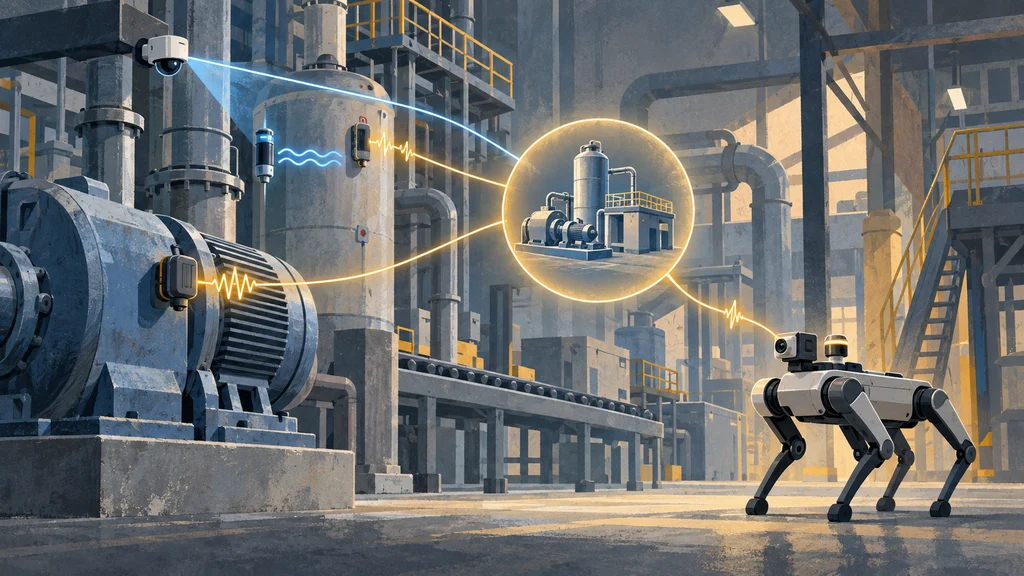
Information from equipment sensors and operating systems can now be connected to the inspection behavior of the four-legged robot Spot.Spot 5.2 combines the data-assembly Orbit with the external input API, which extends the inspection method to video and predictive protection.
The equipment information will become the output condition of the spot.
Spot 5.2 connects the operations of the factory-divided information system and the four-legged walking robot Spot into a single workflow, according to Boston Dynamics, allowing the AI agent to cross and judge information from multiple systems and launch the Spot where it is needed.
This collaboration enables robots to start inspection on the equipment’s side, such as collecting additional data when fixed sensors detect abnormalities. From a configuration that only deals with the robot’s circuit results, the configuration extends to a configuration that passes information already in the facility to the next inspection action.
Orbit connects inspection records to asset classes
The robot operating software Orbit has shifted from a data configuration axed on inspection to a configuration axed on assets such as equipment, which enables the facility’s management system and inspection data to be handled along the same objects.
Orbit incorporates asset classes including metadata such as location, asset type, importance, manufacturer, model, and connects each asset to inspection records. The asset dashboard reduces abnormal trends in units such as the entire facility, the same type of equipment, and equipment in a specific area.
External input and 360 degree images extend the monitoring range
Orbit’s API receives not only data collected by Spot, but also input from PLC sensors and surveillance cameras, and more.
Site Scans can be used to monitor temporary risks by analyzing the Site View 360° image with AIVI-Learning, continuously monitoring the entire facility and specifying the area and time zone to be monitored.
Add video and prediction preservation to the static picture center inspection.
With the inspection using AIVI-Learning, the Spot 5.2 has been able to obtain not only static images but also videos.
For predictive protection, gas detection, imaged vibration analysis, and partial discharge detection 3 features were added.Integrated with the MFE Spot Connected Gas Detection Solution, the Spot can monitor more than 20 types of gases in real time during normal orbits and transmit their atmospheric data to Orbit.
Vibration analysis by image captures the state of the machine by amplifying the tiny movements that are not visible to the naked eye. Partial discharge detection uses Sorama L642 to examine early signs of insulation abnormalities in high-voltage equipment such as cables, buses, and transformers.