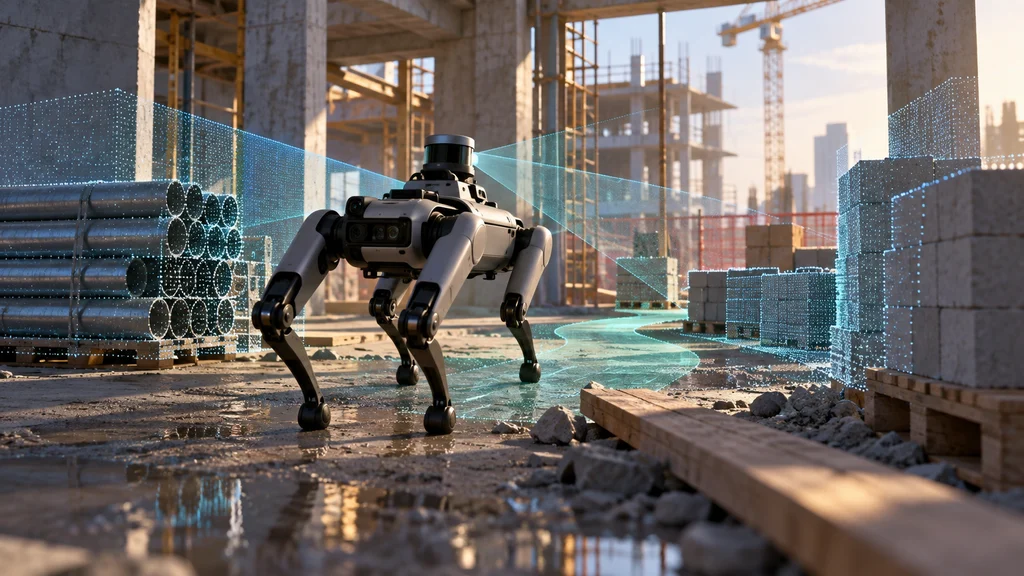
The configuration of a four-legged walking robot that moves through a changing construction site, depending on pre-maps and GPS, was shown.Boston Dynamics and FieldAI integrated the underlying model that deals with Spot’s mobile performance and physical constraints.
Integrate the model to determine the construction site in Spot
Boston Dynamics and FieldAI have developed a Field Foundation Model for robotics based on the foundation and software stack of the four-legged walking robot Spot.FFMSpot is an aircraft intended for industrial inspection and movement in complex environments.FFMjudgment according to the circumstances.
According to the two companies, with this integration, Spot will be able to grasp the state of the construction site and track and record the construction situation.Unlike fixed factories, it is a configuration that extends the subject of autonomous operation to the scene where the terrain and layout continue to change.
Uncertainty and physical constraints reflect moving judgment.
FFM is a “physics-first” basic model designed for physical intelligence, which includes recognition results such as images, as well as uncertainty, risk, and physical constraints of the real world.
Spot’s mobile performance connects its judgment results to actual route choices and moves.Boston Dynamics and FieldAI say the combination with risk-considered decision-making allows them to move around environments that have traditionally been difficult to automate.
GPS removes dependency on the cloud.
According to FieldAI, robots with FFM do not require pre-created maps, GPS, fixed paths, or additional infrastructure for robots.
Judgment processing is completed on-edge, i.e. on a robot that does not require a cloud connection. By removing the computational basis of the communication destination from the premise of moving judgment, places that cannot be connected to the cloud will be included in the subject of autonomous operation.
Connect operational data to the collaboration of multiple robots.
The FFM is designed as a foundation layer that supports multi-agent coordination and control of group units by multiple robots, as well as individual robots.
Each robot collects operational data in different environments.FieldAI will use this data to continuously improve the model and expand the subject of autonomous operation to spaces that have been difficult to predict.